

Your Menstrual Cycle Phases
There's much more to your menstrual cycle than the inconvenience and, for some, the pain associated with your period. A woman's menstrual cycle is often an excellent indicator of the general health of her reproductive and endocrine systems. Whether you're currently trying to get pregnant, planning on conceiving in the future, or are simply interested in consciously caring for your body, a closer understanding of what happens throughout your cycle can help you feel more in control of the process.
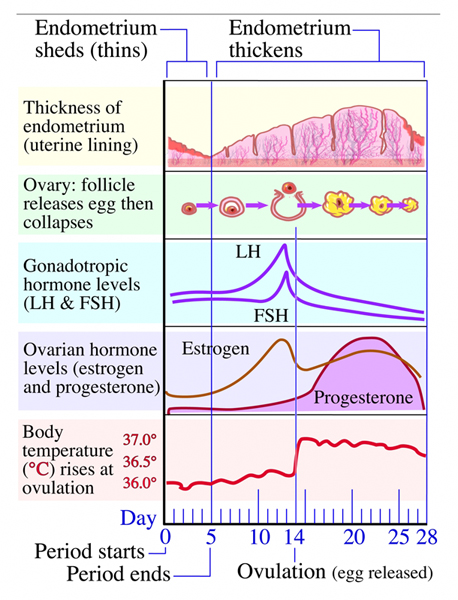
This illustration is based on a 28-day menstrual cycle, considered the most average length of time from the first day of one period to the start of the next one. Keep in mind that women's bodies vary, and anything from 21 to 35 days is still considered within a normal range for menstrual cycle length.
Medical Illustration Copyright © 2020 Nucleus Medical Media. All rights reserved.
The first day of menstrual bleeding is considered Day 1 of a cycle. The chart illustrates how the lining of the uterus builds up so that it's thickest at the time when conception is most likely. The reason: if an egg is fertilized, the newly created embryo will need a protective place to implant.
If conception doesn't happen, the hormones LH & FSH take a dip in levels and the endometrium sloughs off - Day 1 of your menstrual period.
The next phase begins when bleeding ceases. Your hypothalamus and pituitary glands start producing more FSH & LH, which tells the ovaries to prepare one of the egg follicles - a small sac -- to mature. The follicle itself produces estrogen, which in turn tells the endometrium to plump up again.
The high estrogen level causes FSH to decrease. Around the middle of your cycle, a mature egg is released from the follicle: ovulation.
Note that there's a rise of about .5 to 1.6 degrees in your temperature at or just after the point of ovulation. This explains why charting your basal body temperature (BBT) is good for gauging how regularly you ovulate and helpful to predict your next cycle's most fertile time, but not so helpful at telling you when you've ovulated in your current menstrual cycle.
The remains of the follicle (shown in yellow) dissolve and start emitting progesterone. If you've conceived, the progesterone and estrogen levels will remain higher than when you're not pregnant. This is the cause of the ongoing elevated temperature you see in the BBT chart. If pregnancy has not occurred, your hormones will drop off, your basal body temperature will generally lower, and the menstrual cycle begins again.
Disclaimer: The information provided in this document is for educational purposes only. It is not medical advice and is not intended as a substitute for medical advice. Only your own physician knows all the important details of your specific medical and personal history and should be the only one to give you advice regarding your own medical care. You should never disregard medical advice or delay seeking medical advice or treatment because of something you have read herein. If you have any questions whatsoever about your medical health or believe you have a medical problem or disease, you should contact your medical doctor or healthcare provider.
